

11+ non-verbal reasoning explained: shapes, sequences and rotations
Non-verbal reasoning is the paper that makes parents feel useless. There is no vocabulary to revise and no method from school to fall back on, just grids of shapes and a child saying "I don't know, it just looks right".
It is also the paper that improves fastest with practice, because behind the variety there are only a handful of things a question can actually be doing.
What it is testing
Non-verbal reasoning uses shapes and patterns rather than words, so it depends less on vocabulary and reading speed than the rest of the test. Selective schools like it for exactly that reason: in theory it looks past what a child has been taught and past how strong their English is.
In practice, familiarity with the format matters enormously, which is why children who have seen a few hundred of these questions look so much more able than children who have seen none.
The question families
Almost every non-verbal question is one of these:
- Series and sequences: four shapes in order, pick the fifth.
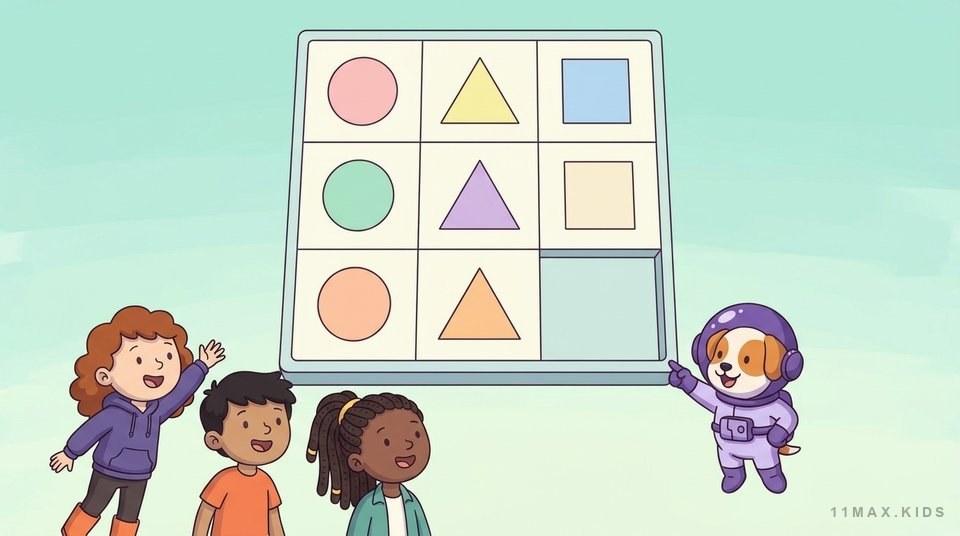
- Matrices: a three-by-three grid with one cell missing.
- Odd one out: four figures share a rule, one breaks it.
- Analogies: A is to B as C is to which option.
- Rotation and reflection: the same figure turned or mirrored.
- Codes: figures labelled with letter pairs, work out what each letter encodes.
- Nets and 3D: fold a flat net into a cube, or spot the matching solid.
- Hidden and combined shapes: which option contains the given shape, or two shapes layered together.
Spatial questions (rotation, reflection, nets) are where children divide most sharply, and they are also the most trainable, because the underlying skill is mental manipulation and it responds to repetition.
The one method worth teaching
Almost every non-verbal question comes down to finding which attribute is changing. There are only about six candidates, so a child who works through them in a fixed order will solve far more than a child who stares and waits for the answer to arrive.
The checklist, in order:
- Number: how many shapes, sides, dots or lines?
- Shape: has the shape itself changed?
- Shading: black, white, striped, dotted?
- Size: bigger, smaller, alternating?
- Position: has something moved, and by how much?
- Rotation or reflection: has it turned, and which way?
Teach your child to name the change out loud. "The dots go up by one, the shading swaps every time." A child who can say the rule can check it against every option; a child who cannot is guessing, even when they guess correctly.
Then eliminate. Non-verbal answers are multiple choice, and options usually break the rule in obvious ways once the rule is named. Ruling out three options is faster and more reliable than finding the right one directly.
The practice problem nobody warns you about
Non-verbal reasoning is the subject where families run out of material. There are only so many published books, and children memorise them: a child who recognises a question has stopped practising reasoning and started practising recall. Parents notice the scores rising and mistake it for progress.
This is the reason 11max generates its non-verbal questions rather than serving a fixed bank. Each family (sequences, matrices, rotations, odd one out, analogies, codes) is a generator, so the questions your child sees are new, the difficulty follows what they are currently getting wrong, and a strong run cannot be explained by having seen the page before.
How much to do
Little and often, like everything else in the home practice routine. Ten to fifteen minutes of non-verbal, three or four times a week, will take most children from bewildered to comfortable within a couple of months. Start earlier than feels necessary: this is the subject with the steepest and shortest learning curve, so it rewards the families who begin before the panic.
And if you find yourself unable to see the answer either, that is not a bad sign. Non-verbal reasoning is genuinely easier for a ten-year-old brain than an adult one, and children are usually delighted to be the one explaining it. Let them. The explaining is the practice. Then check where it sits in the wider picture of the test.